
English
- 中文
- English
English
- 中文
- English

News and information
Publish real-time updates or messages to provide you with industry information
Xinhua News Agency: 7 milliseconds "flash" 2080 kilometers! This' China Road 'leads the world
2023-04-25 09:21:16
Click:
“
On November 15, 2022, in Butuo County, Liangshan Yi Autonomous Prefecture, Sichuan Province, the last wire laying section of the Sichuan section of the State Grid Baihetan Zhejiang ± 800 kV ultra-high voltage direct current transmission project was successfully completed, achieving full line connection
”
On November 15, 2022, in Butuo County, Liangshan Yi Autonomous Prefecture, Sichuan Province, the last wire laying section of the Sichuan section of the State Grid Baihetan Zhejiang ± 800 kV UHVDC transmission project was successfully completed, achieving full connection and marking the full connection of the Baizhe project.
On July 1st recently, the Baihetan Jiangsu ± 800 kV ultra-high voltage direct current project was completed and put into operation. As the strategic artery of China's "West to East Power Transmission" project, this project spans 5 provinces and cities, with a total length of 2080 kilometers, and can transmit hydropower from Sichuan to Jiangsu in just 7 milliseconds.
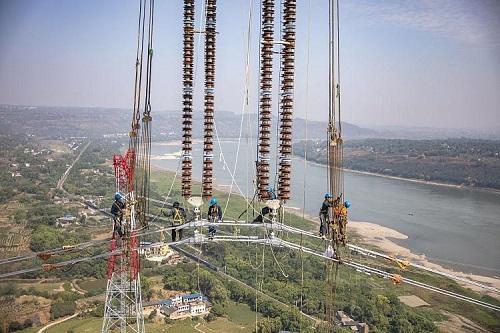
On September 13, 2022, the Chongqing section of the Baihetan Zhejiang ± 800 kV ultra-high voltage direct current transmission project successfully completed the Yangtze River Crossing.
Behind the 7-millisecond transmission speed of electricity is China's world leading ultra-high voltage technology. Every year, trillions of kilowatt hours of electricity are transmitted through ultra-high voltage transmission lines with a length of over 48000 kilometers, crossing the mountains, rivers, lakes, and seas of our country, and being sent to the forefront of economic development.
In the international context of "no standards, no experience, and no equipment", China's ultra-high voltage has successfully achieved the transformation from "starting from scratch" to "a major power tool", from "created by China" to "led by China", and from "equipping China" to "equipping the world". This can be said to be a difficult, innovative, and challenging major achievement in the history of China's power development, and it is also an important milestone in the development of China and even the world's power industry.
A huge loss caused by a branch
In August 2003, at the peak of power consumption in the United States, a high-voltage cable touched a branch and led to the shutdown of a power plant in Ohio. This seemingly inconspicuous short circuit event triggered the butterfly effect - a blackout occurred in the area centered on the Great Lakes in North America, and 50 million people living in New York, Michigan, Ohio, Massachusetts, Connecticut, and northern New Jersey in the eastern United States suddenly fell into darkness, Even parts of Ontario and New England in Canada have been affected.

On August 14, 2003, in New York, USA, citizens queued up to use public telephones, and New York was hit by a large-scale power outage.
Behind the $30 billion loss caused by a tree branch is the mismatch between the growth of electricity demand in the United States and its power transmission capacity. Aging lines and lagging power grid construction are all deep-seated causes of major power outages.
Not only in the United States, but also in countries such as France, Russia, and China at that time, the development of transmission technology and power grid construction were difficult problems.
As a major manufacturing country, in order to develop the real economy in China, the rice bowl of energy must be in its own hands. The reality is that two-thirds of the country's coal resources are concentrated in Shaanxi, Shanxi, and Inner Mongolia provinces, with 80% of hydropower resources concentrated in the southwest region, and photovoltaic and wind energy resources mainly concentrated in northwest, Inner Mongolia, and other regions. Correspondingly, over 70% of China's energy consumption is concentrated in the eastern and central regions.
Large scale, long-distance, and high loss energy transportation is by no means an easy task. The essence of the problem with the development mode of electricity is a lack of understanding of the functional positioning of the power grid, insufficient long-term investment in the power grid, lagging development, and insufficient ability to optimize energy resource allocation.
As early as July 1986, Wang Fengming and Zhang Yixin, experts from Wuhan High Voltage Research Institute (now China Electric Power Research Institute Wuhan Branch), proposed to develop ultra-high voltage power grid and realize the external transmission of thermal power in their paper "Centralized distribution of plants in coal bases using ultra-high voltage transmission lines is an important way to solve the difficulties of coal transportation". This year, China began the "Pre research on UHV AC Transmission" project.
In June 1994, China's first million volt level ultra-high voltage transmission research line was completed at Wuhan High Voltage Research Institute. However, for nearly 20 years thereafter, due to weak research capabilities in ultra-high voltage technology and immature development conditions for the power grid, China's ultra-high voltage power grid construction has always remained at the conceptual level.
Unprecedented construction
Why must we develop ultra-high voltage technology?
Let's start with the voltage level in our country. In China, voltage levels are divided into five categories: safe voltage, low voltage, high voltage, ultra-high voltage, and ultra-high voltage.
In the 1980s, China's electricity demand grew rapidly, resulting in a tense situation of electricity consumption, especially in the economic center of China, such as East China, where severe power shortages occurred.
In 1983, with the first and second phases of the Gezhouba Power Plant being put into operation for power generation, a batch of 500 kV transmission and transformation projects began construction on the land of Hubei and Central China. With the rapid development of the economy and society, ± 500 kV ultra-high voltage transmission technology has also encountered a supply ceiling, and it is necessary to continue to increase transmission power and enter the ultra-high voltage field.
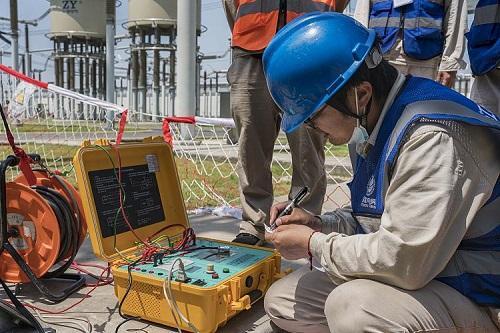
On June 8, 2022, at the ± 800 kV Taizhou converter station, power workers are conducting maintenance work on electrical equipment.
Ultra high voltage power grid refers to DC power grid with ± 800 kV and above and AC power grid with 1000 kV and above. Compared with ordinary transmission lines, ultra-high voltage transmission lines have larger transmission capacity, higher transmission efficiency, smaller operating losses, and longer transmission distances, reaching 2000 kilometers or even more, covering all large energy bases and power load centers in China.
Compared with ± 500 kV ultra-high voltage direct current transmission, the distance of ± 800 kV and ± 1100 kV ultra-high voltage direct current transmission has increased by 2-3 times and 5-6 times respectively, and the transmission capacity has increased by 2-3 times and 4-5 times respectively. The transmission loss is less than 1/2 and 1/4, and the corridor width per unit capacity is only 65% and 55%, and the unit cost is only 65% and 40%.
Unlike fields such as bridges and civil engineering, China has basically started from scratch in terms of transmission technology. Moreover, there is no mature international method to learn from, no ready-made tools to use, and even no industry standard specifications for on-site operations for ultra-high voltage technology.
Since the 1960s, countries such as the United States, the Soviet Union, Japan, and Italy have successively conducted research and development on ultra-high voltage transmission technology. In the 1980s, the Soviet Union built 1150 kV ultra-high voltage AC transmission lines, and Italy and Japan also completed ultra-high voltage test projects.
However, after the dissolution of the Soviet Union, there was a significant lack of electricity demand, resulting in the operation of ultra-high voltage lines being reduced to 500 kV after only a few years of operation. After World War II, although Japan's electricity consumption increased with the economic recovery, the objective reality is that the country's land area is less than 380000 square kilometers, and the demand for ultra-high voltage long-distance and large capacity transmission is not as strong as that of major countries. In addition, the economic crisis soon after led to a decrease in demand, and substations still use 500 kV equipment.
In short, looking at the world, the United States, Japan, and Italy have all studied and developed ultra-high voltage transmission technology, but due to various reasons, it has stagnated or postponed, and even reduced the transmission voltage level.
No one has ever done this before. Li Lixuan, an academician of the CAE Member, later said, "We can't stop doing it because we don't exist abroad, because it's what our country needs."
In 2005, the State Council officially included ultra-high voltage in the "Outline of the National Medium and Long Term Science and Technology Development Plan (2006-2020)".
In 2006, the development of ultra-high voltage complete equipment was included in the "Several Opinions on Accelerating the Revitalization of the Equipment Manufacturing Industry". In August of that year, the 1000 kV Jindongnan Nanyang Jingmen ultra-high voltage AC test demonstration project was approved by the state.
We must take the path of independent innovation
Faced with the huge market opened up by China's ultra-high voltage construction, international companies such as Siemens, BBC, and Schneider have seized on some of China's shortcomings in ultra-high voltage development technology and are selling their own technological solutions. The first ± 500 kV high-voltage direct current transmission line in China, the Gezhouba to Shanghai Gehu Line, built in 1986, is a complete set of technical equipment imported from BBC Corporation (later merged with Asia Corporation to form ABB Corporation)








MORE INFORMATION
-

Suqian, Jiangsu: Mobile Substation Assists Major Projects in Production
In recent years, Suqian, Jiangsu Province has been committed to building a "Photovoltaic City", with a group of leading enterprises in the photovoltaic industry settling down and putting into operation. To assist major industrial projects in early power connection, production, and efficiency, the local government continues to optimize the electricity business environment and introduces mobile substation leasing
View Details -
Xinhua News Agency: 7 milliseconds "flash" 2080 kilometers! This' China Road 'leads the world
On November 15, 2022, in Butuo County, Liangshan Yi Autonomous Prefecture, Sichuan Province, the last wire laying section of the Sichuan section of the State Grid Baihetan Zhejiang ± 800 kV ultra-high voltage direct current transmission project was successfully completed, achieving full line connection
View Details -
Several Opinions of the National Energy Administration on Accelerating the Development of Digital and Intelligent Energy
The opinion points out that by 2030, the digital and intelligent innovation application system for various aspects of the energy system will be preliminarily constructed, and the potential of data elements will be fully activated. A number of common key technologies that restrict the development of digital and intelligent energy will have made breakthroughs, and the intelligence of the energy system will be enhanced
View Details -
Introduction to the Principle and Function of DC Screen
Principle of DC screen: When AC power is normal, it converts AC power into DC power to charge the battery, and also supplies power to the closing bus and control bus. When AC power is lost or faulty, the battery supplies power to the closing bus and control bus. straight
View Details -
Specific Introduction to Six Electric Energy Storage Methods
In recent decades, the research and development of energy storage has been attached great importance by energy, transportation, power, telecommunications and other departments in various countries. Electrical energy can be converted into chemical energy, potential energy, kinetic energy, electromagnetic energy, and other forms of storage, which can be mainly divided into mechanical forms according to their specific methods
View Details -
When "new energy distribution and storage" becomes a must answer question, what does the energy storage market need?
In 2022, China's newly added wind and solar power generation accounted for more than 55% of the country's new electricity generation, marking that wind and photovoltaic power has gradually become the main power generation entity in China. Against the backdrop of the booming development of the new energy industry, energy storage is the core technology to solve the instability of wind and solar power generation
View Details


Jiangsu Chuneng Engineering Technology Co., Ltd
Striving for excellence, collaborative innovation, service-oriented, and win-win development

点击右上角
分享给朋友吧
Copyright © All owned by Chuneng Engineering

Contact +
Address: No. 93 Taihangshan Road, Suqian High tech Industrial Development Zone, Jiangsu Province
Tel/Fax: 0527-84498789
Nanjing Branch: Room 909, Building C5, Greenland Window, No. 5 Jinxiu Street, Yuhua District, Nanjing City
Mobile: 15195866722 Phone/Fax: 025-83371808
Scan code to follow

Jiangsu Chuneng Engineering Technology Co., Ltd
Striving for excellence, collaborative innovation, service-oriented, and win-win development
Contact +
Address: No. 93 Taihangshan Road, High tech Industrial Development Zone, Suqian City
Tel/Fax: 0527-84498789
Nanjing Branch: Room 909, Building C5, Greenland Window, No. 5 Jinxiu Street, Yuhua District, Nanjing City
Mobile: 15195866722 Phone/Fax: 025-83371808
Scan code to follow
点击右上角
分享给朋友吧
Copyright © All owned by Chuneng Engineering
